
If you’ve ever picked up a guitar and thought: “I wish I could just play something…”
You’re already closer than you think. Improvisation isn’t about knowing everything on the instrument.
It’s about knowing just enough to start participating in music in real time.
And one of the most powerful ways to begin?
👉 The minor pentatonic box
The Big Idea: Guitar Is Transposable
Before we even talk about the shape, we need to understand why this works.
That means…
- If you learn something once, you can move it somewhere else, and it still works.
This is what we mean when we say guitar is transposable. And this is exactly why the pentatonic box is such a powerful tool for improvisation.
It works because the because:
- The notes all work over the major key. The minor pentatontic is borrowed from the relative minor, meaning it’s the same notes as the major key.
- The different order of the notes gives the solo a slightly different flare and flavor.
- The shape works on the 6th no matter what key you are in.
The Minor Pentatonic Box
Instead of memorizing a bunch of notes, we start with the first position shape.

How to Improvise in Any Key (Step-by-Step)
This is the exact process we teach beginners.
Step 1: Identify the Key
Start by figuring out the key of the song.
For example:
- C major
- G major
- D major
Step 2: Match It to the Relative Minor
Here’s the trick that makes everything work:
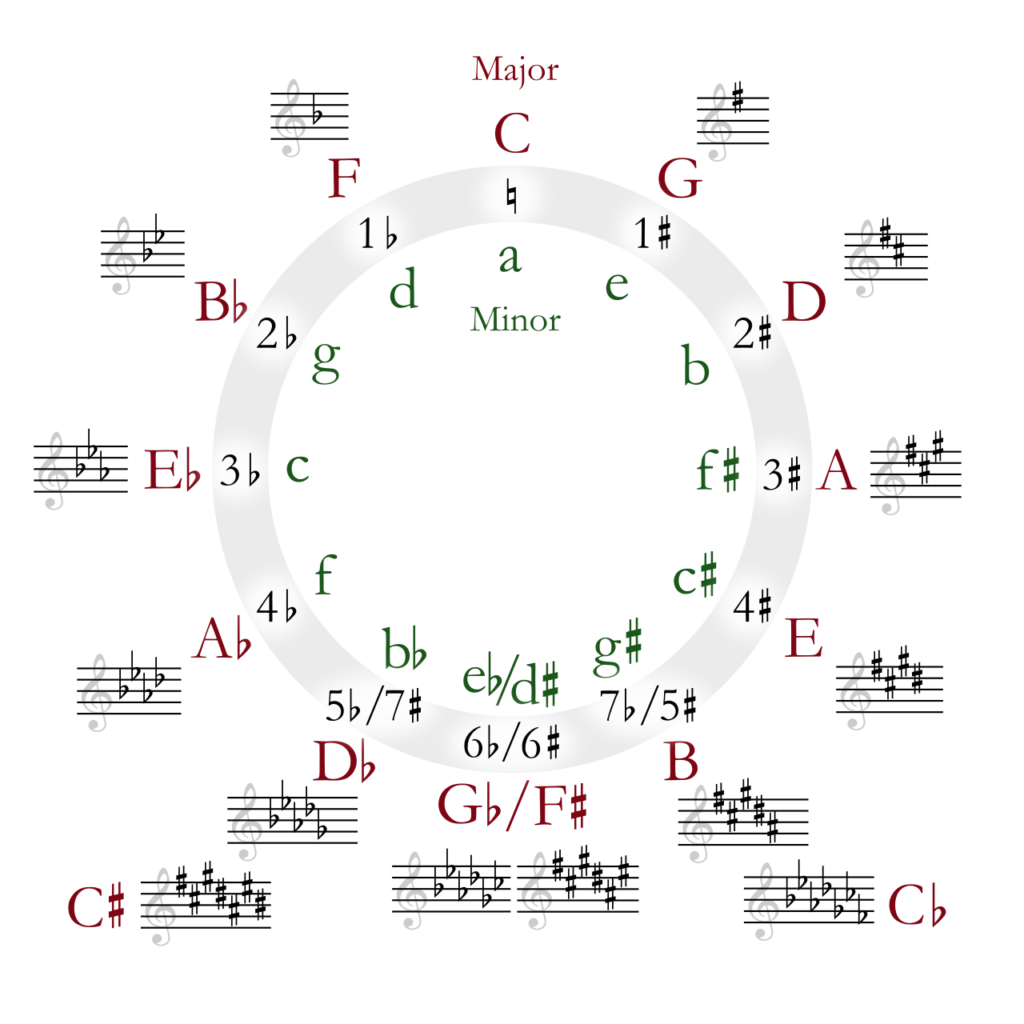
Every major key has a relative minor that uses the same notes.
Examples:
- C major → A minor
- G major → E minor
- D major → B minor
You can find this either counting 6 notes up from “Do” (the first note), or by pulling up a picutre of the circle of fifths.
Quick shortcut:
👉 Go down 3 frets from the major key (counting the one you’re on).
That’s your relative minor.
Step 3: Find That Note on the Guitar
Now find that minor root note on your guitar.
Example:
- Key = C major
- Relative minor = A minor
- Find A on the low E string (5th fret)
That note is your anchor.
Step 4: Play the Minor Pentatonic Box
Once you’ve found the root:
👉 Build your minor pentatonic box around that note.
You are now:
- In the correct key
- Using the correct notes
- Ready to improvise
Step 5: Start Playing
Now comes the fun part. But keep it simple. If you pull up tabs.com or a similar website and see something like “solo” or “instrumental break” try playing a simple solo in that section. Remember, it doesn’t have to be complex, this is more about continuing the musical conversation than anything else.
