The Secret to Strumming
Master the rhythm grid before learning specific patterns
Before you start learning strumming patterns for particular strums, this is where you begin. You want to start to hear the “4/4 grid” in your head. This exercise helps you train your hand to move consistently with the beat, so you’re not guessing your way through rhythm. Think of it less like a metronome or a pendulum.
We can break up strum patterns esentially into groups of two or three. In 4/4, we break things up into groups of two. Even when there are beats that are rests (no sound), I often still move my hand to keep that movement going. This is the same way someone might bob their head or stomp their foot.
The Foundation: Understanding the 4/4 Grid
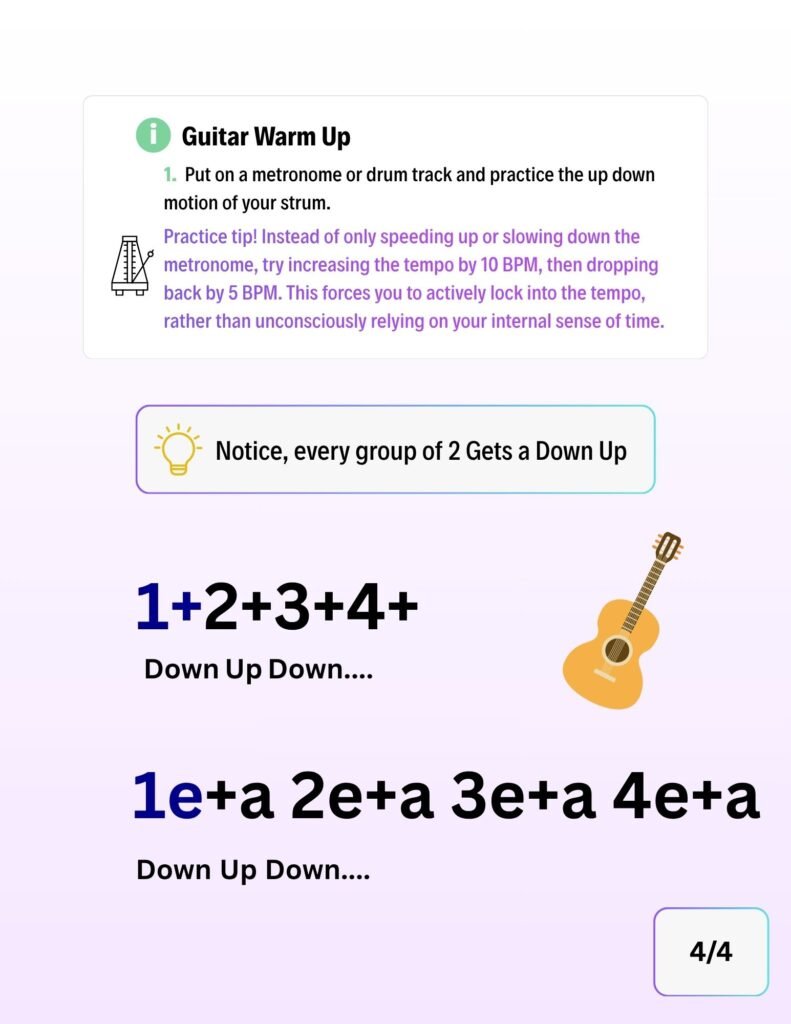
Think of music as a grid. In 4/4 time, that grid divides each measure into four beats, and between each beat, your hand moves. We call this the down-up pattern.
The 4/4 Down-Up Pattern
Each measure contains 8 hand movements: down-up-down-up-down-up-down-up
⭐ The Secret
Even when there's no sound on certain beats, you keep your hand moving. Your hand doesn't stop—it keeps going down-up-down-up. This is the same way someone might bob their head or stomp their foot to music.
💡
Notice: Every group of 2 Gets a Down-Up
Why This Matters
Most beginners stop their hand when they're not strumming. This breaks the rhythm and forces you to "guess" where the beat is when you need to strum again. But if you keep your hand moving consistently, you're always connected to the pulse of the music.
The 4/4 Warm-Up Exercise
This exercise trains your hand to move consistently with the beat. You're building muscle memory for the rhythm grid.
Practice Pattern: Single Measure in 4/4
Repeat this pattern continuously for 1-2 minutes at a steady tempo
🎯
The Goal: Consistent Hand Motion
Your hand should move like a pendulum—smooth, even, and uninterrupted. Don't think about where the strings are. Just let your hand keep moving to the beat.
Practice Tips for 4/4
- Start at a slow tempo (80-100 BPM) where you feel relaxed
- Use a metronome or drum track to keep time
- Keep your hand moving even on rests
- Once comfortable, gradually increase the tempo
- Aim to do this warm-up for 2-3 minutes before each practice session
Introducing 6/8: The Three-Beat Feel
Now we shift gears. In 6/8 time, instead of breaking rhythm into groups of two, we break it into groups of three. This creates a different feel—lighter, more flowing.
The 6/8 Pattern: Emphasis & Weight
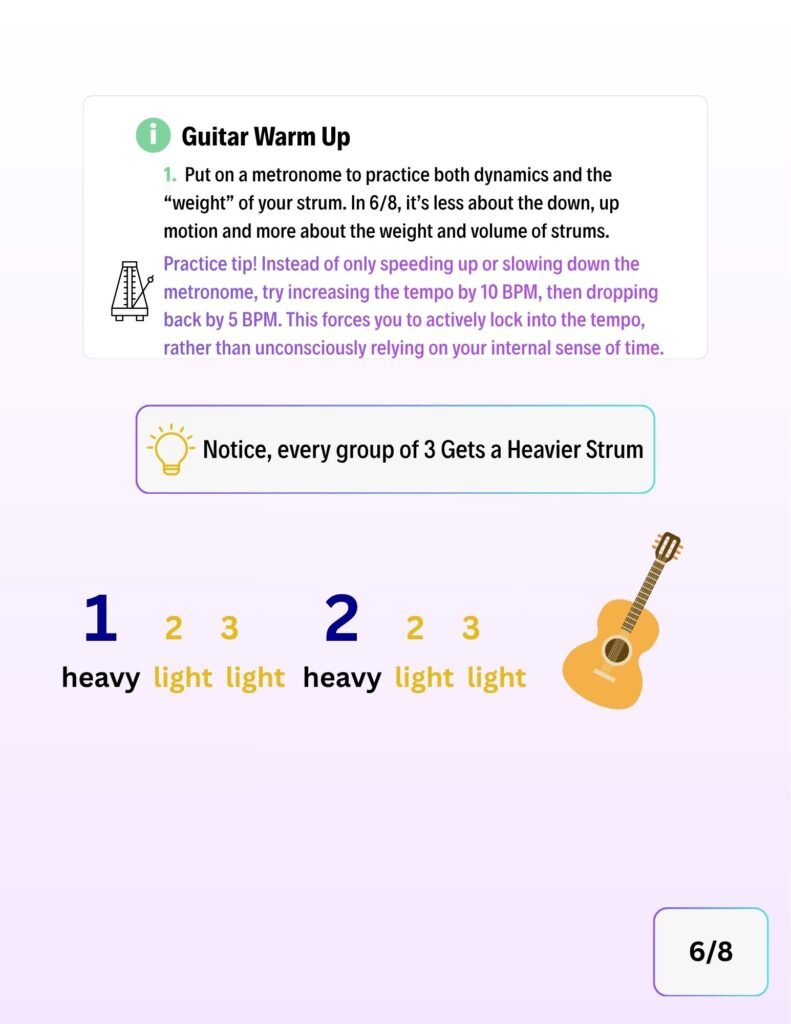
6 beats per measure, grouped in two sets of three. Heavy emphasis on beats 1 and 4.
💡
Notice: 6/8 Groups Things in Threes
1 2 3
First group of three
Shifting From Motion to Weight
This warm-up introduces the feel of 6/8 by shifting your focus from motion to weight. Instead of thinking strictly in down-up patterns, you'll start to feel how certain beats carry more emphasis than others.
💡 The Shift
By grouping the rhythm into sets of three, you develop a natural sense of flow, where one strum leads into the next with intention. The heavier beats (1 and 4) ground the pattern, while the lighter beats flow between them.
Practice Pattern: Single Measure in 6/8
Repeat this pattern continuously. Feel the weight on beats 1 and 4 (darker strums).
Practice Tips for 6/8
- Start at a slow tempo (60-80 BPM)
- Feel the grouping: 1-2-3, 1-2-3
- Make beats 1 and 4 sound heavier or more emphasized
- Let beats 2, 3, 5, 6 be lighter and flow naturally
- Think about the rhythm in triplets—three-note groupings
- Once comfortable, increase the tempo gradually
Building Your Daily Practice
Here's how to structure your practice sessions to master these foundational rhythms:
10-Minute Warm-Up Routine: The +10/-5 Method
- Minutes 0-1: 4/4 pattern at 60 BPM (get your hand loose)
- Minutes 1-2: 4/4 pattern at 70 BPM (up 10)
- Minutes 2-3: 4/4 pattern at 65 BPM (down 5)
- Minutes 3-4: 4/4 pattern at 75 BPM (up 10)
- Minutes 4-5: 6/8 pattern at 70 BPM (down 5, shift to triplet feel)
- Minutes 5-6: 6/8 pattern at 80 BPM (up 10)
- Minutes 6-7: 6/8 pattern at 75 BPM (down 5)
- Minutes 7-9: Mix 4/4 and 6/8 at varying tempos (stay flexible)
- Minutes 9-10: Challenge round: alternate every 30 seconds
🎯
Why +10/-5? Break the Autopilot
If you stay at one tempo, your hands lock in and you stop thinking. By constantly changing tempo—going up 10 BPM then down 5—you force yourself to stay present and adjust. This prevents muscle memory from turning into mindless repetition, and builds real rhythmic flexibility.
✓ Success Indicator
You'll know you've mastered this when you can do these patterns without thinking about your hand. It should feel automatic, like tapping your foot.
What Comes Next?
Once you're comfortable with these foundational patterns, you're ready to:
Building On Your Foundation
- Learn specific strum patterns (like folk strum, pop strum, etc.)
- Add silence—muting strings at specific points for rhythm variation
- Combine 4/4 and 6/8 patterns in the same song
- Play along with actual songs and backing tracks
- Develop your own unique strumming style
But here's the thing: don't skip this foundation. Every great guitarist spends time getting these basic rhythms into their muscle memory. It pays off exponentially when you start learning more complex patterns.